The Morning Glory of the Gulf of Carpentaria
Douglas Christie and Russell White
First published AOPA January 1995
General Description
The
Morning Glory, a spectacular propagating roll cloud which frequents the
sparsely populated southern margin of the Gulf of Carpentaria, is one of
the world's most exotic and interesting meteorological phenomena. Morning
Glories (see Figure 1) are frequently observed during the spring months
near dawn over the southern Gulf area between Sweers Island and the remote
community of Burketown in northern Queensland. They often appear in the
form of one or more, rapidly advancing, rather formidable roll cloud formations
which extend from horizon to horizon in a long arc as far as the eye can
see. The cloud is usually about 3000 feet in depth with a base at about
1000 feet above the surface. On occasion, the base of the cloud may lie
below 300 feet AGL and the depth may exceed 6000 feet.
The leading roll cloud in Morning Glory disturbances tends to be very
smooth along the front and turbulent along the back. Subsequent cloud formations,
if present, are nearly always turbulent and often appear only in the form
of scattered lines of irregular cumulus.
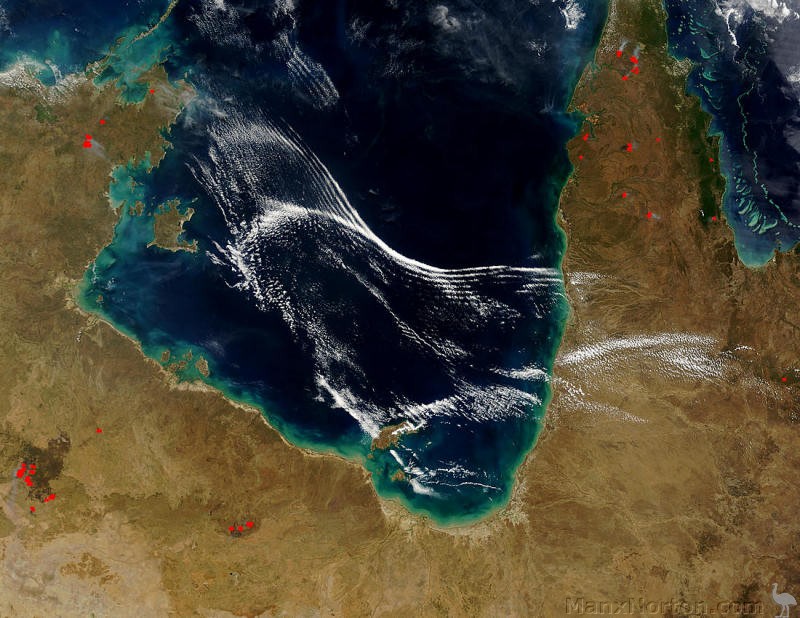
Recent
studies have shown that Morning Glory roll cloud formations often extend
in length for over 1000 kilometres (see Figure 2).
Despite their ominous appearance, they seldom produce measurable precipitation,
but are almost always accompanied by a short-lived, but often intense,
wind squall near the surface which may be a potentially serious wind shear
hazard for aircraft. Morning Glories propagate on average with speeds of
about 40 kilometres per hour, but occasionally are observed to travel at
speeds of over 60 kilometres per hour. Morning Glories tend to occur on
a daily basis at Burketown over periods ranging from three to seven days
in succession.
Solitary Waves
Morning
Glory roll cloud formations are visible manifestations of largeamplitude
solitary waves. Solitary waves are somewhat unusual in that they occur
as singular waves with one isolated crest. Waves of this type propagate
as exceptionally long-lived disturbances in waveguides created by stable
layers in the lower atmosphere. A feature of larger-amplitude solitary
waves is the region of trapped recirculating cooler air in the interior
of the wave which may be transported by the wave over considerable distances.
Solitary
waves occur commonly throughout much of the arid interior of the Australian
continent and elsewhere. Waves in inland areas almost invariably occur
without cloud as clear-air disturbances accompanied by a sudden wind squall
at the surface and a temporary increase in surface pressure. When sufficient
moisture is present near the surface, as is often the case over the southern
Gulf of Carpentaria region, large amplitude waves of this type may be accompanied
by what appears to be a propagating roll cloud formation. In this case,
cloud is created continuously in the up-draught along the leading edge
of the wave as moist ambient air from near the surface is lifted to the
condensation level. Cloud elements are then eroded away as air parcels
descend in the down-draught along the trailing edge of the wave. The clearly
visible upward motion of cloud elements along the leading edge and the
downward motion of cloud elements along the trailing edge of the wave combine
to give the impression that the cloud formation is rolling backwards as
it advances.
Conditions
over the tropical southern margin of the Gulf of Carpentaria between the
months from August to November prior to the onset of the Wet are particularly
favourable for visible solitary waves. Indeed, the southeast corner of
the Gulf is the only known location where spectacular roll cloud formations
of this type can be regularly and predictably observed. Roll cloud formations
probably accompany more than eighty percent of all Morning Glory disturbances
during the spring months as they propagate off-shore over the southern
Gulf. Conditions are not as favourable over land; nevertheless, nearly
half of all disturbances which occur within 100 kilometres of the coast
are accompanied by roll clouds.
Origin
Three
distinct types of Morning Glory waves have now been identified: northeasterly
Morning Glories which appear most frequently just before sunrise over the
Burketown area, southerly waves which can appear over the Burketown region
at any time of day except during the afternoon and early evening, and southeasterly
waves which tend to be active primarily during the early morning hours.
More than half of all disturbances observed at Burketown belong to the
category of northeasterly waves. These disturbances originate during the
previous evening in the collision between two opposing intense tropical
seabreeze fronts over the highlands of the Cape York Peninsula. Waves of
this type propagate at night towards the southwest over the Gulf of Carpentaria,
arriving near dawn over Burketown. The cloud formation associated with
northeasterly Morning Glory waves dissipates fairly rapidly as the disturbance
moves inland into drier air over northern Queensland. Even after the cloud
dissolves, however, the disturbance continues to propagate inland, often
for distances in excess of two hundred kilometres, as a clear-air wind
squall.
The genesis of southerly Morning Glory waves remains obscure. Some of
these waves have very large amplitudes and may be accompanied by spectacular
roll cloud formations; other southerly waves take the form of relatively
minor disturbances with amplitudes of only a few hundred feet. There is
clear evidence to show that some southerly disturbances originate over
the interior of the Australian continent in the interaction of a mid-latitude
cold front with a developing nocturnal radiation inversion. Little is known
with certainty about the origin or properties of morning glories which
arrive at Burketown from the southeast. Some of these waves appear to be
generated by thunderstorms which often develop in the late evening over
the region to the northeast and east of Mount Isa.
The genesis and propagation of Morning Glories is controlled by synoptic
conditions which turn out to be nearly identical for all types of wave.
Thus, northeasterly, southerly and southeasterly waves may occur simultaneously
over the southern Gulf region. Favourable conditions for the occurrence
of Morning Glory waves at Burketown include a significant pressure ridge
over the east coast of the Cape York Peninsula, absence of storm activity
over the Burketown region and a well-developed sea-breeze regime over the
southeastern Gulf area on the preceding day.
These conditions are enhanced by the presence of an inland heat trough
and an advancing frontal trough system south of the Gulf of Carpentaria.
The presence of an inland heat trough and ridging over the eastern Cape
York Peninsula will almost always guarantee that a northeasterly Morning
Glory will arrive at Burketown on the following morning. It has proven
to be fairly difficult, however, to predict the precise arrival time of
northeasterly Morning Glories over the Burketown area, the size of these
disturbances and whether or not these disturbances will be accompanied
by a spectacular roll cloud formation.
Soaring on the Morning Glory
The art of soaring on the Morning Glory was pioneered in an historic
flight by Robert Thompson and Russell White on 13 October, 1989 in a motorised
Grob-109 glider. Robert and Russell and other experienced glider pilots
have since completed more than a dozen successful flights on Morning Glory
waves, some of which have lasted for more than three hours and have covered
distances of over three hundred kilometres. These flights have generated
considerable interest in the gliding community and it appears that Burketown
is set to become a Mecca for gliding enthusiasts from around the world.
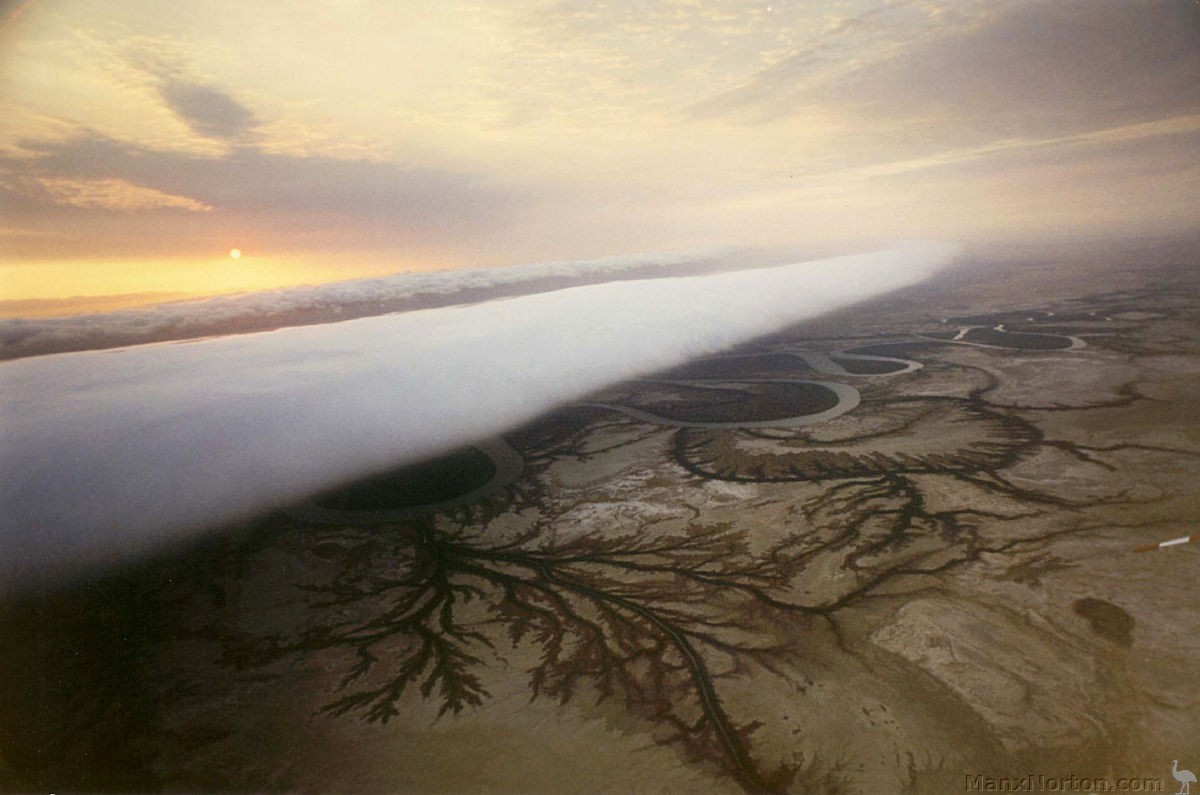
A photograph of a Morning Glory disturbance which was taken while soaring
in the Grob-109 is shown in Figure 3.
Soaring on the Morning Glory at speeds which are comparable with existing
world record speeds is one of the most exciting and exhilarating experiences
that the gliding world has to offer. A typical flight starts with a motor-assisted
take-off at first light from the sealed strip at the Burketown aerodrome.
All flights to date have been carried out on northeasterly Morning Glories.
In most cases, the Morning Glory is first encountered over the Gulf as
a moving mountain of cloud while the aircraft is still at a fairly low
altitude. At this point the aircraft is directed along the axis of the
wave and the engine is switched off. The glider then ascends very rapidly
in the strong updraft along the face of the advancing roll cloud. This
is perhaps the most exciting and scenic portion of the flight.
The strong updraft along the leading edge of the wave extends over a
broad area ahead of the wave above the top of the cloud and provides useful
lift to heights of at least 10000 feet AGL. This means that the flight
direction along the axis of the roll cloud can be safely reversed with
ease at any time. Flights of more than 300 kilometres along the length
of the wave may be possible in some cases, but the pilot must always keep
in mind that the wave is eventually going to disappear as it moves inland
over very inhospitable terrain with very few possibilities for a safe landing.
It is for this reason that we strongly recommend that soaring on the Morning
Glory should be restricted in most circumstances to motorised gliders.
Glider pilots should also be aware that the trailing edge of Morning
Glory waves harbours potentially dangerous down-draughts which could leave
any aircraft which has been unfortunate enough to end up on the wrong side
of the wave in a precarious position. Attempts to fly under Morning Glory
roll clouds could also lead to disaster and should be avoided. One other
potential hazard which glider pilots should steer clear of is the large
amplitude disturbance in the form of a localised breaking wave which may
appear at the point of intersection between two independent interacting
Morning Glories. The point of intersection where these isolated breaking
waves occur is often obscured over the Gulf by a developing thunderstorm
triggered by the large amplitude of the disturbance at that point.
The 1994 Morning Glory Season
Some of the most spectacular Morning Glory wave disturbances seen in
recent years occurred during the months of September and October, 1994.
Several successful flights on these waves were made by a number of glider
pilots. A particularly spectacular Morning Glory occurred near dawn on
the 20th of October. Russell White and co-pilot Karin Jurgenson, who normally
pilots the Burketown Pub's Cessna-337, launched in the Grob-109 at first
light and almost immediately encountered a strong clear-air Morning Glory
wave with strong turbulence. Having radioed a warning not to launch to
the other glider pilots, they feathered the prop and headed northwest into
the gloom towards a developing rollcloud illuminated by the full moon with
just a hint of colour from the rising sun. It was astonishingly beautiful.
By dawn they were over Point Parker on the coast at 6000 feet, with
the cloud now well formed ahead and continuing out to sea in the general
direction of Gove. A sheer wall of cloud several thousand feet high designated
an area of extremely strong lift so a speed run over the next 100 kilometres
was deemed essential. This led to ground speeds in excess of 125 knots.
The lift was so strong it was impossible to keep the glider from climbing
at 400 feet per minute even at speeds close to VNE in the impeccably smooth
air during this phase .
As the glider passed the Edward Pellew Group of islands the roll cloud
evaporated leaving only some scattered clouds to indicate the position
of the wave. With some trepidation, the pilots cautiously picked their
way across a large expanse of blue sky towards what appeared to be a developing
cumulonimbus in the direction of Groote Eylandt. This proved to be a reforming
visible Morning Glory cloud line with cumulus breaking through on top.
Soaring along the front of this line at 8000 feet at high speed was spectacular,
with cloud tops, accompanied by isolated lenticulars, rising to well over
10000 feet. This particular Morning Glory was by far the largest Morning
Glory ever seen from the air at such close quarters.
The flight continued past the southern side of Groote Eylandt to less
than 30 kilometres out from Numbulwah on the western side of the Gulf with
the coast of Maria Island just visible to the south. At this point the
cloud line started to disintegrate again and so the pilots reversed direction
and soared along the wave back to the southern coast of the Gulf which
they crossed in the vicinity of West Island, some 30 kilometres east of
Booroloola. Shortly after, the cloud evaporated as the wave moved inland
and the lift died.
It was time to celebrate. The pilots had established a new long distance
record for soaring on the Morning Glory. They had soared a touring glider
over 700 kilometres in not much over 4 hours, mostly over water, at an
average speed more in keeping with that of a racing glider out for a world
record attempt. Karin quite enjoyed her first glider flight.
The unusually large amplitude Morning Glory on the 20th of October was
not the only spectacular wave during the 1994 season. On the 29th of October,
a Baron departed Normanton after the first wave of a northeasterly Morning
Glory went through and experienced a climb rate of 3000 feet per minute
along the leading edge of the second wave. As the Baron's usual climb rate
is about 1200 to 1500 feet per minute, it would be safe to conclude that
the lift along the front of the primary wave in this event could have been
as high as 20 knots.
This northeasterly disturbance comprised at least 10 visible roll clouds.
At almost the same time, a set of three southerly Morning Glory waves passed
over the Burketown airstrip at about 30 knots, each perfectly formed and
stretching from horizon to horizon. From the air, a 360 degree turn in
the glider revealed literally dozens of waves in nearly every sector of
the sky as yet another set of Morning Glories arrived over the southern
Gulf region from the southeast. Claude Nowland, a resident of Burketown,
claimed that the Morning Glory display on the morning of October 29 was
one of the most spectacular displays that he has ever seen during his 17
years in Burketown.
Wind Shear and Air Safety
Studies
of Morning Glory solitary waves have provided considerable insight into
the aviation wind shear problem. Potentially hazardous wind shear occurs
whenever variations in either horizontal or vertical wind components cause
an aircraft to deviate from its intended flight path. Convective microbursts,
solitary waves and thunderstorm gust fronts are generally regarded as the
most serious forms of wind shear hazard in the airport environment. In
contrast with microbursts and gust fronts which are always associated with
thunderstorm activity, solitary waves represent a particularly insidious
threat to aircraft because they may appear without warning over the runway
area during final approach or take-off, when safety margins are minimal,
as sudden transient clear-air disturbances.
The leading updraft and trailing down-draughts in intense solitary wave
disturbances may exceed 20 knots and the horizontal wind component near
the surface can vary by more than 30 knots during the passage of the wave.
Aircraft which encounter a solitary wave from the front (the structure
of a typical family of solitary waves is shown in Figure
4) will rise above the intended flight path under the influence of the
leading up-draught and increasing headwinds. The natural reaction of a
pilot at this point is to attempt to return to the normal glide path, but
this action, when combined with the sudden loss of headwind and increasing
downdraughts behind the wave can leave the aircraft perilously close to
ground, well short of the runway threshold. The situation faced by a pilot
may be more complicated when the aircraft encounters more than one solitary
wave while on final approach. In this case, the winds acting on the aircraft
may give the appearance of alternating head and tail wind components, thus
compounding the problem of aircraft control. It seems clear that, given
the choice, pilots should avoid landing or flying through propagating roll
cloud formations like the Morning Glory.
Conclusion
The
remote, sparsely populated southeast corner of the Gulf of Carpentaria
is the only known location where Morning Glory roll clouds occur regularly
and predictably at certain times of the year. A visit to Burketown or Sweers
Island in September or October to view, or perhaps even to soar on, this
unique natural phenomenon can be a very exciting and rewarding experience.
Suggestions for further reading
Christie, D.R. and Muirhead, K.J. 1983. Solitary waves: a hazard
to aircraft operating at low altitudes.
Aust. Met Mag., 31, 97-109. Doviak, R.J. and Christie, D.R. 1989. Thunderstorm-generated
solitary waves: a wind shear hazard. J. of Aircraft, 26, 423-43 1.
White, R. 1991. The Morning Glory. Australian Gliding, 40, 34-40.
Christie, D.R. 1992. The morning glory of the Gulf of Carpentaria: a
paradigm for non-linear waves in the lower atmosphere. Aust. Met Mag.,
41, 21-60.
This article is also published at the Burke
Shire Council site.
|