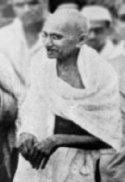
Mohandas Karamchand "Mahatma" (Sanskrit:
"great
soul")
Gandhi (October 2, 1869 - January 30, 1948) was one of
the founding fathers of the modern Indian state and an influential advocate
of pacifism as a means of revolution. (See also: Mahatmas.)
He helped bring about India's independence from British rule, inspiring
other colonial peoples to work for their own independence and ultimately
dismantle the British Empire and replace it with the Commonwealth. Gandhi's
principle of satyagraha (Sanskrit: truth + path/way), often roughly
translated as "[way of truth]", has inspired generations of democratic
and anti-racist activists including Martin Luther King, Jr. and Nelson
Mandela.
Gandhi was born on October 2, 1869, in Gujarat, India. He was the son
of a local official and trained as a lawyer in London. He went to South
Africa to practise law in 1893 and began his political career by lobbying
against laws discriminating against Indians in South Africa.
Gandhi drew inspiration from the writings of Leo Tolstoy, who in the
1880s had undergone a profound conversion to a personal form of Christian
anarchism. Gandhi translated Tolstoy's "Letter to a Hindu" which was written
in 1908 in response to aggressive Indian nationalists, and the two corresponded
until Tolstoy's death in 1910.
During World War I, Gandhi returned to India, where he campaigned for
Indians to join British Indian Army. After the war, he became involved
with the Indian National Congress and the movement for independence. He
gained worldwide publicity through his policy of civil disobedience and
the use of fasting as a form of protest, and was repeatedly imprisoned
by the British authorities (for example on March 18, 1922 he was sentenced
to six years in prison for civil disobedience but only served only 2 years).
One of his most striking actions was the salt march that started on March
12, 1930 and ending on April 5, when he led thousands of people to the
sea to collect their own salt rather than pay the salt tax. In Bombay,
on March 3, 1939 Gandhi began to fast in protest of the autocratic rule
in India.
Gandhi became even more vocal in his demand for independence during
World War II, drafting a resolution calling for the British to Quit
India, which soon sparked the largest movement for Indian independence
ever, with mass arrests and violence on an unprecedented scale. During
this time, he even hinted an end for his otherwise unwavering support of
non-violence, saying that the 'ordered anarchy' around him was 'worse than
real anarchy'.
Gandhi was a larger-than-life figure in relations between the Hindu
and Muslim communities of India. It is said that he ended communal riots
through his mere presence. Gandhi was vehemently opposed to any plan which
partitioned India into two separate countries (as the plan which was eventually
adopted did--creating a Hindu-dominated India, and a Muslim-dominated Pakistan).
On the day of power transfer, Gandhi did not celebrate independence with
the rest of India, but mourned partition alone in Calcutta instead. He
was assassinated by Naturam Godse, a Hindu radical who held him responsible
for Partition, in New Delhi on January 30, 1948.
See also: Vinoba
Bhave - Subhas
Chandra Bose - Sarojini
Naidu