The
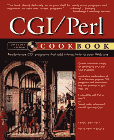
CGI/Perl Cookbook
by Craig Patchett, Matthew Wright (Contributor), Peter Holfelder (Contributor)
Book Description: Custom subroutine library for developing your
own CGI programs
-
Line-by-line explanations of 20 of the most popular CGI programs and subroutines
that are essential to your Web site
-
Compatible with Perl 4 and 5
-
Tested under Windows, UNIX, and MacOS
If you want to make your Web site as interactive as possible, as soon as
possible, you've come to the right place! This book/CD powerhouse arms
you with 20 of today's most-demanded CGI programs and subroutines, designed
and written...
Paperback - 624 pages Bk&Cd-Rom edition
(October )
John Wiley & Sons; ISBN: 0471168963 |
| |
Perl
Database Programming
by Brent Michalski
Paperback from John Wiley & Sons
28 October, 2002
Network
Programming with Perl
by Lincoln D. Stein, Lincoln D. Stein
Paperback from Addison-Wesley Pub Co
Genomic
Perl: From Bioinformatics Basics to Working Code
by Rex A. Dwyer
Hardcover from Cambridge University Press
The
Perl Cd Bookshelf, Version 3.0: 7 Bestselling Books on Cd-Rom
by O'Reilly & Associates
Paperback from O'Reilly & Associates
Learning
Perl (3rd Edition)
by Randal L. Schwartz, Tom Christiansen, Larry Wall (Foreword)
In this smooth, carefully paced course, a leading Perl trainer teaches
you to program in the language that threatens to make C, sed, awk, and
the Unix shell obsolete for many tasks. This book is the "official" guide
for both formal (classroom) and informal learning. It is fully accessible
to the novice programmer. Amazon.com
Paperback: 330 pages ; Dimensions (in inches):
0.83 x 9.24 x 7.04
Publisher: O'Reilly & Associates; 3rd
edition (July 15, )
ISBN: 0596001320 |
| |
Programming
Perl
by Larry Wall, Tom Christiansen, Randal L. Schwartz, Stephen Potter
Larry Wall wrote Perl and he wrote Programming Perl. Better yet, he
writes amusingly and well--all of which comes across in this latest edition
of the definitive guide to the language.
Like Topsy, Perl just grew, and as a result the need for a third edition
came about. It's now over 1,000 pages, which it needs to be, as it performs
several different duties. First, it's an introduction to the Perl language
for those who are new to programming; also, it's a guide for those who
are coming from other languages; and, finally, it's a Perl language reference.
Among Larry Wall's other pursuits is being a linguist, and it's perhaps
for this reason that Perl is a peculiarly flexible language with many routes
to achieving the same ends, as the authors ably demonstrate. It's also
extensible in several ways, designed to work with many other languages.
Also, as it's largely interpreted, programs written in Perl tend to run
unmodified on a variety of platforms--although platform-specific Perl modules
and programming practices are also discussed.
A major strength of Programming Perl is the way subject areas are approached
from several directions. This constant shift of viewpoint eliminates blind
spots in the reader's understanding and provides a pleasing echo of the
way Perl itself can take many routes from here to there.
Because the Perl community is both knowledgeable and active, the language
covers much more ground here than in the previous edition. Even if you
have both previous editions, you'll want this latest version--if only for
the new jokes. --Steve Patient, amazon.co.uk
Paperback - 645 pages 2nd edition
O'Reilly & Associates; ISBN: 1565921496 |
| |
Advanced
Perl Programming
by Sriram Srinivasan
Book Description: So you've learned Perl, but you're getting
frustrated. Perhaps you've taken on a larger project than the ones you're
used to. Or you want to add a user interface or a networking component.
Or you need to do more complicated error trapping.
Whether your knowledge of Perl is casual or deep, this book will make
you a more accomplished programmer. Here you can learn the complex techniques
for production-ready Perl programs. This book explains methods for manipulating
data and objects that may...
Paperback - 434 pages 1 Ed edition
O'Reilly & Associates; ISBN: 1565922204 |
| |
Mastering
Regular Expressions : Powerful Techniques for Perl and Other Tools
(Nutshell Handbook)
by Jeffrey E. F. Friedl, Andy Oram (Editor)
Paperback - 368 pages
O'Reilly & Associates; ISBN: 1565922573
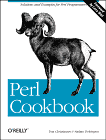
Perl
Cookbook
by Tom Christiansen, Nathan Torkington, Larry Wall
When the second edition of Programming Perl was released, the authors
omitted two chapters: "Common Tasks with Perl" and "Real Perl Programs."
Publisher O'Reilly & Associates soon realized that there would be too
many pages in Programming Perl if it put updated recipes in the new edition.
Instead, O'Reilly chose to release the many Perl code examples as a separate
entity: The Perl Cookbook.
The recipes are well documented and the examples aren't too arcane;
even beginners will be able to pick up the lessons taught here. The authors
write in relatively easy-to-understand language (for a technical guide).
Through this book and its arsenal of recipes, you will learn many new things
about Perl to help you through your toughest projects. The next time you're
working on a project at 2 a.m., you'll thank yourself for the guidance
and direction The Perl Cookbook provides. --Doug Beaver - Amazon.com
Paperback - 794 pages 2 Ed edition
O'Reilly & Associates; ISBN: 0596003137 |
| |
Regular
Expression Pocket Reference
by Tony Stubblebine
Paperback from O'Reilly & Associates
Programming
Perl (3rd Edition)
by Larry Wall, Tom Christiansen, Jon Orwant
Paperback from O'Reilly & Associates
Mastering
Regular Expressions, Second Edition
by Jeffrey, E. F. Friedl
Paperback from O'Reilly & Associates
Computer
Science & Perl Programming: Best of TPJ
by Jon Orwant
Paperback from O'Reilly & Associates
Learning
Perl, Third Edition
by Randal L. Schwartz, Tom Phoenix
Paperback from O'Reilly & Associates
Learning
Perl Objects, References and Modules
by Tom Phoenix, Randal L. Schwartz, Damian Conway
Paperback from O'Reilly & Associates
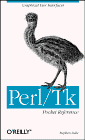
Perl/Tk
Pocket Reference
by Steve Lidie, Stephen Lidie
Book Description: The Perl/Tk Pocket Reference is a companion
volume to Learning Perl/Tk, an O'Reilly Animal Guide. Learning Perl/Tk
is a tutorial for Perl/Tk, the extension to Perl for creating graphical
user interfaces. With Tk, Perl programs can be window-based rather than
command-line based, with buttons, entry fields, listboxes, menus, scrollbars,
balloons, tables, dialogs, and more. And Perl/Tk programs run on UNIX and
Windows-based computers.
This small book is a handy reference guide geared toward the advanced
Perl/Tk programmer. Novice Perl/Tk programmers will find that its compact
size gives them a global view of Perl/Tk's capabilities; they can then
turn to Learning Perl/Tk for details. The Perl/Tk Pocket Reference describes
every Perl/Tk graphical element, including general widget and variable
information, callbacks, geometry management, bindings, events, and window
management, as well as composite widget, font, and image creation and manipulation
commands.
Paperback - 100 pages Pocket edition (December
)
O'Reilly & Associates; ISBN: 1565925173 |
| |
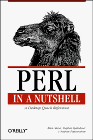
Perl
in a Nutshell : A Desktop Quick Reference
by Ellen Siever, Stephen Spainhour, Nathan Patwardhan
Perl in a Nutshell strives to be a perfect set of socket tools for
the active Perl programmer. By and large, it succeeds, providing endless
and well-thought-out lists and tables on the language's modules, flags,
and extensions. The authors briefly address basic learner's questions--such
as the difference between a hash and an array--but these concepts are not
the purpose of the book. (Those new to Perl would be better off with others
in the O'Reilly Perl series, such as Learning Perl, while programmers making
the switch to Perl can pick up the nuances of the language with Programming
Perl.) This book is pure Perl reference, briefly covering Perl/Tk (for
GUI Perl programs on Unix and Windows 95/NT) and Perl for Win 32.
The authors do start at the very beginning, and even in a self-described
"desktop quick reference" find the time to comment on less urgent--but
still interesting--Perl-related matters (like how to find online help amidst
the "Perl culture"). The format of the book makes sections on topics such
as Perl debugging easily understandable, illustrating how to make an interactive
and timesaving environment.
Of particular convenience is the outstanding section on the standard
Perl modules. A four-page "quick look" allows you to easily scan through
short definitions of all the modules and find the entry you're looking
for. An index with full definitions for each module follows, showing you
how to use each module and providing a more in-depth explanation (and often,
examples). Perl in a Nutshell concludes--as you might expect--with an excellent
and well-cross-referenced index. --Jennifer Buckendorff
Paperback: 800 pages ; Dimensions (in inches):
1.39 x 9.00 x 6.04
Publisher: O'Reilly & Associates; 2nd
edition (June )
ISBN: 0596002416 |
| |
Programming
Web Graphics With Perl and Gnu Software
by Shawn P. Wallace, Richard Koman (Editor)
Paperback - 454 pages 1 Ed edition (April
)
O'Reilly & Associates; ISBN: 1565924789
Programming
Perl (Nutshell Handbook)
Larry Wall (Editor), et al
Paperback
Writing
Apache Modules With Perl and C
by Lincoln Stein, Doug MacEachern, Linda Mui (Editor)
Paperback - 724 pages 1 Ed edition (April
)
O'Reilly & Associates; ISBN: 156592567X