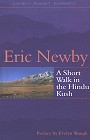
A
Short Walk in the Hindu Kush
by Eric Newby
Preface by Evelyn Waugh
For more than a decade following the end of World War II, Eric Newby
toiled away in the British fashion industry, peddling some of the ugliest
clothes on the planet. (Regarding one wafer-thin model in her runway best,
he was reminded of "those flagpoles they put up in the Mall when the Queen
comes home.") Fortunately, Newby reached the end his haute-couture tether
in 1956. At that point, with the sort of sublime impulsiveness that's forbidden
to fictional characters but endemic to real ones, he decided to visit a
remote corner of Afghanistan, where no Englishman had planted his brogans
for at least 50 years. What's more, he recorded his adventure in a classic
narrative, A Short Walk in the Hindu Kush. The title, of course, is a fine
example of Newby's habitual self-effacement, since his journey--which included
a near-ascent of the 19,800-foot Mir Samir--was anything but short. And
his book seems to furnish a missing link between the great Britannic wanderers
of the Victorian era and such contemporary jungle nuts as Redmond O'Hanlon.
At times it also brings to mind Evelyn Waugh, who contributed the preface.
Newby is a less acidulous writer, to be sure, and he has little interest
in launching the sort of heat-seeking satiric missiles that were Waugh's
specialty. Still, A Short Walk in the Hindu Kush is a hilarious read. The
author excels at the dispiriting snapshot, capturing, say, the Afghan backwater
of Fariman in two crisp sentences: "A whole gale of wind was blowing, tearing
up the surface of the main street. Except for two policemen holding hands
and a dog whose hind legs were paralysed it was deserted." His capsule
history of Nuristan also gets in some sly digs at Britain's special relationship
with the violence-prone Abdur Rahman: Officially his subsidy had just been
increased from 12,000 to 16,000 lakhs of rupees. To the British he had
fully justified their selection of him as Amir of Afghanistan and, apart
from the few foibles remarked by Lord Curzon, like flaying people alive
who displeased him, blowing them from the mouths of cannon, or standing
them up to the neck in pools of water on the summits of high mountains
and letting them freeze solid, he had done nothing to which exception could
be taken.
Newby also surpasses Waugh--and indeed, most other travel writers--in
another important respect: he's miraculously free of solipsism. Even the
keenest literary voyagers tend to be, in the purest sense of the term,
self-centered. But A Short Walk in the Hindu Kush includes wonderfully
oblique portraits of the author's travel companion, Hugh Carless, and his
wife, Wanda (who plays a starring role in such subsequent chronicles as
Slowly down the Ganges). There are also dozens of brilliant cameo parts,
and an indelible record of a stunning landscape. The roof of the world
is, in Newby's rendering, both an absolute heaven and a low-oxygen hell.
Yet the author never pretends to pit himself against a malicious Nature--his
mountains are, in Frost's memorable phrase, too lofty and original to rage.
Which is yet another reason to call this little masterpiece a peak performance.
--James
Marcus - Amazon.com
Paperback: 260 pages
Lonely Planet; ISBN: 0864426046;
|