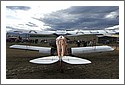
September 19 1941 saw the first flight of an Australian designed
aircraft that contained some interesting and indeed innovative features.
The aircraft, officially known as the Wackett bomber, was designated the
CAC-CA-4.
It came about because of a perceived need to replace
the Beaufort with an aircraft to meet the immediate needs of RAAF development
specification no. 241. This called for an aircraft suitable for reconnaissance
and general bombing, with a capability for torpedo delivery and dive bombing.
Wackett's design was for a low wing, twin engine,
light bomber with a crew of three. It featured four forward firing machine
guns operated by the pilot, two remote controlled twin machine gun barbettes
mounted on the rear of the engine nacelles, engine nacelles that as well
as housing the undercarriage, carried two 250 lb bombs. Under the fuselage
were mounting points for two torpedoes, (either of which could be replaced
by a 293 gallon drop tank) or two 500 lb bombs, with a provision for four
25 lb bombs under each wing.
The second pilot had his own instrument panel and
a demountable control column, and was expected to operate the remote barbettes
through the use of a sighting periscope. The third crew member was the
bomb aimer/navigator. He was placed in the lower rear fuselage and had
a window between his feet as well as triangular windows in the fuselage
for navigation. He was also equipped with a free slung machine gun that
could be fired from the ventral step.
The bomber was powered by by two P&W twin wasp
R-1830-S3C3-G radials. Six fuel tanks were an integral part of the centre
section wing construction, causing headaches for the designers as this
had never before been done on an Australian designed machine. The wings
were of stressed skin construction, with the control surfaces being fabric
covered aft of the spar, and dynamically balanced. The cockpit and nose
of the aircraft were metal skinned, and the fuselage was canvas covered
ply.
The initial flight tests showed disappointing response
to the controls with the elevator being almost ineffectual, and severe
engine overheating. Despite this it was agreed that the aircraft's general
handling was on par with contemporary machines. Testing and modifications
continued and unexpectedly showed up another feature that Wackett claimed
was deliberate, but had never mentioned before. During a flight to show
the CA4 to the prime minister and other defence officials, the undercarriage
failed and a wheels up landing was made. The machine stopped in 100 yards
with no structural damage, and only minor damage to the engines. In fact
it was removed from the strip by lifting it onto it's undamaged undercarriage
and towing it away. Repairs only took two days, and inspection revealed
that the failure had been caused by an act of sabotage.
April 20 1942 saw the RAAF accept the Wackett bomber
for trials. The machine proved capable but had features that were unacceptable
to the military, such as the remote aiming and firing system. However in
competition with the Beaufort VIII it proved superior in speed, armament,
ordinance carrying capacity and range, with similar handling. The Beaufighter
came closer, but again lost to armament, load and range. The RAAF was sufficiently
impressed with the CA4 to order 105 CA-11 Woomera bombers on March 8 1942.
Unfortunately the only CA-4 was destroyed when it exploded in flight due
to a fault in a feathering switch and a leaking fuel tank on 15 January
1943.
The Woomera was essentially the same aircraft but
it carried all the modifications that had been made to the CA-4, plus some
redesign work. The canopy was extended to cover the whole crew area, the
tail and rudder was completely redesigned, the deck of the fuselage cut
down, and more dihedral put into the outer wing sections. The pilots armament
was modified to include two cannon and two machine guns.
At this time the CAC factory was busily completing
Wirraway orders, and the new Boomerang. It had also transpired that the
role of twin engined aircraft had changed in the course of the development
of the Woomera. The need for dive/torpedo bombers had been passed in favour
of heavily armed medium bombers, which the RAAF had available in the form
of the Mitchell and Boston. An updated and more powerful version known
as CA-11a was mooted, but due to the non-availability of the chosen engines
the idea was abandoned. Add this to the promise of Liberators and the project
was doomed. The original order for 105 machines was reduced to 20. However,
like the CA-15 the Woomera was to become a "project" rather than a contender.
This notwithstanding, the first flight of the CA-11
was cautiously considered a success. The difficulties in controlling the
machine on the ground had gone, as had the lack of feel and control on
the elevators and rudder. However the ailerons despite being identical
to those on the CA-4 were delightful at flying speed, but decidedly unsatisfactory
at low speed. This coupled with a worrying vibration caused the CAC test
pilot G.A. Board some worry. Further test flights followed, with most of
the problems being quickly rectified, only the vibration and rudder overbalance
needing attention. During dive tests a severe vibration was experienced,
followed by difficulty in raising the nose due to lack of stick movement.
Board flew the aircraft slowly home and eventually had to fly it onto the
strip, being unable to lower the tail. Post flight inspection showed that
the vibration had caused the elevator trim tab to break and jam the control.
Sqn. Ldr. Cuming of 1 A.P.U was brought in to give
a second opinion as he had flown the CA-4. Board flew chase in a Boomerang
and noticed that the tailplane tips were vibrating through an arc of 6
inches, and that the whole of the fuselage rear of the navigators position
was vibrating torsionally. This was obviously an aerodynamic problem, but
it had not shown up in wind tunnel tests. It was finally traced to the
disturbance of airflow caused by the turrets on the rear of the engine
nacelles striking the underside of the tailplane, and rectified by giving
the tailplane a dihedral of 12 degrees.
By this stage, the second Woomera was almost complete,
only wanting engines, and a further six were partially constructed. Then,
in the first week of September 1944, the program was cancelled. Test flights
continued for another twelve months, with the test aircraft being converted
to components in January 1946.