Felix Noble - Aviation Writer and Illustrator
Australian Aviation History

HomeContactWarbirdsAviatorsSitemapWarbirdssLinkpage
 
 
Posters
Aviation Posters
Aviation Posters
Featured Site
Aircraft and Aviation Webring
Aviation Webring


Brough's Aviaton Books
Aviation Books

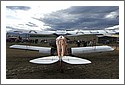
The Winjeel CA-22
With the end of the war the RAAF was, along with the rest of the military, reduced. However at the same time the need for modernisation was recognised, and the jet era had been entered. The RAAF hierarchy decided that a new trainer was required to replace the very obsolete Tiger Moth fleet, and old technology Wirraway trainers. The aircraft had to be simple enough for ab initio training, but complex enough to lead onto the more advanced types entering into service, specifically the upcoming Vampire jets. Allied to this was the wish of the government of the day who insisted that any new trainer had to be constructed with as many Australian made components as possible to strengthen the Australia aircraft industry. At this time, The British air force was also looking for a twin seat trainer with similar specifications, and CAC decided to try for both contracts. Australian specification AC.77 was drawn up in February 1948 to quantify the various requirements.

    The new aircraft required twin seating, with a provision for a third person, C.S.U., fixed undercarriage, an engine of proven type with at least 600 hours between overhauls, engine controls to the left of each pilot, and amongst a long list of other things, good spinning characteristics. CAC’s submission was the CA-22, which on paper exceeded all the specifications, and with an eye for future development of their design, CAC also included provision for retractable undercarriage. The prototype was to be powered by a Pratt & Whitney Twin Wasp, whilst CAC developed their own radial for the production versions.

    CAC was awarded a prototype contract for two aircraft in May 1949 and after eighteen months of structural and wind tunnel tests, the first CA-22 was rolled out on January 26 1951 and flown three weeks later. Unusually, the testing of the CA-22 was carried out from the beginning with the involvement of the air force in an attempt to speed up the process. This did not work as it was soon found that the prototype had handling problems, most insignificant, but one almost insurmountable; the aeroplane was so stable that it was very reluctant to spin. The stall was effected with little or no warning, and the port wing would usually drop very suddenly, followed by the nose, but recovery was quick and simple a spin would not develop unless very deliberately and strongly sought. Major airframe and aerodynamic changes were made, including raising the height of the fin by 18" (45 cm) and moving it forward by 3’ (98 cm). When this didn't have the desired effect, the engine also was moved 7" (18 cm) forward. Finally by mid 1952 the aeroplane reached a performance which satisfied the RAAF in spins. (This however was still somewhat unusual in that to enter a stable spin you were required to cross the controls at the point of stall.)

    The CAC radial was constructed, a seven cylinder geared radial of 350 hp named the Cicada, but after flying in a prototype, it was discontinued in favour of the Pratt & Whitney Twin Wasp. By the end of 1952 the CA-22 was ready for production, and in early 1953 it was used by various RAAF stations for evaluation purposes. The British at some stage decided that they preferred their own design , the Percival Prentice, (despite the fact that it was not as capable as the CA-22, and it eventually was replaced by the Provost which co-incidentally bore a marked similarity to the CA-22) and the Australian government couldn't decide what to do. Despite the fact that 62 CA-22s were ordered in 1951, the government vacillated until late 1954 before finally confirming the order, and allowing production to commence. In that time, the final configuration had been decided, drawings made, contractors lined up and the aircraft re-designated CA-25, Winjeel (aboriginal for Little Eagle).

    The first production Winjeel was handed over to the RAAF on August 31st 1955 by Sir Lawrence Wackett, and the last in January 1958. During this time CAC prepared various drawings for conversion of the Winjeel to other configurations, including a six seat light transport machine, and an air ambulance. Further drawings encompassed tricycle undercarriage, twin Turbomeca Aspin II engines, an agricultural Pratt & Whitney turboprop powered aircraft, and a Rolls Royce Dart turboprop jet trainer. None of these plans came to fruition however, and the Winjeel remained in general service until 1969 when the change to "all through" jet training was effected. In that time the Winjeel came to be a highly regarded training aircraft capable of being soloed in slightly longer than the Tiger Moth, despite being markedly more complex. The spinning characteristics caused no problems, and the serviceability was excellent.

    The "all through" scheme turned out to be a bad idea, and the Winjeel was reinstated as the ab initio trainer after only two courses had been completed. It continued to serve until 1977 when the last Winjeel was removed from Point Cook.

    During the Vietnam war, Forward Air Controllers (FAC) were using Cessna Skymasters, and the air force decided in 1969 that it should train its own FACs, and therefore authorised four Winjeels to be modified for this role, despite their lack of suitability for the job. This done, the aircraft were based at 2 OCU Williamtown and formed into no. 4 flight in 1970. Their job was to train army and air force pilots in the FAC tasks. Ten years later the flight was absorbed into 77sqn, and then in 1989 into the newly re-formed 76sqn. There they stayed until they were replaced in 1994 by the Pilatus PC9.

    From its first flight to its final service usage in 1994 is almost exactly forty years. During that time the Winjeel has come up with an enviable reputation as a reliable and enjoyable aeroplane to fly, so much so that it is now a popular machine with "warbird" enthusiasts. This remarkable service life can be equalled by few aircraft, and in the Australian military services only one other machine approaches it; the Iroquois helicopter. Even world-wide there are few machines that can compete, the only one to spring to mind being the venerable Dakota.

Aircraft of the CAC by Felix Noble

Copyright © Felix Noble 1997
Felix at wildudesign.com

Motorcycle Magazines, Toys, Collectibles
Dropbears.com
Navigation
Home | Bookstore | Sitemap
Warbirds | Links | Contacts