Felix Noble - Aviation Writer and Illustrator
Australian Aviation History

HomeContactWarbirdsAviatorsSitemapWarbirdssLinkpage
 
 
Posters
Aviation Posters
Aviation Posters
Featured Site
Aircraft and Aviation Webring
Aviation Webring


Brough's Aviaton Books
Aviation Books

Wackett Trainers
Aircraft of the CAC
In 1938 the Australian government decided to proceed with the design and manufacture of an indigenous ab initio trainer. Tenders were called for, and the recently formed Commonwealth Aircraft Company (CAC) was chosen with its CA-2 design.

    The RAAF specifications called for a low winged monoplane with a tandem closed cockpit. The aircraft was required to have full instrumentation and controls in both cockpits, and unlike the Gipsy Moth had to be flyable solo from either cockpit. Maximum speed was to be at least 209kmh, endurance three and a half hours, and a rate of climb of 10 000 feet in eighteen minutes. The Air Force specified also that the 130hp Gipsy Major motor must be used.

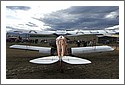
    CAC’s design, eventually known to the public as the "Wackett", ( after its designer, and head of CAC, Lawrence Wackett) was of mixed material construction. The fuselage was a chrome-moly frame, alloy skinned to the rear cockpit, and fabric skinned aft of there. The tail plane, fin and rudder were wooden, as was the entire wing structure. Undercarriage was fixed, with a non steering but castoring tail wheel.

    By March 1939 the engine was mounted, and the major airframe components were coming together. At this time however, CAC was in the final stages of building the factory, and also finishing off its first Wirraway, so progress on the "Wackett" was slow as a result, with the first prototype not ready to fly until two weeks after the war in Europe had begun.

    The first flights showed the design to be pleasant and easy to fly, though Wackett was unhappy with the performance of the engine, deeming it to be too weak. He recommended the fitting of a Gipsy Six motor instead, which would not require any airframe modification, and was readily available from a "Gannet". The second prototype was thus modified, also being fitted with slots behind the outboard sections of the leading edges of the wing, to improve controllability near the stall.

    Flown in early November the second prototype showed no degradation of the earlier models flying characteristics, and a much improved performance. On the downside however was the unacceptable rise in the stalling speed and the still overly long take off run. Wackett suggested that reducing the weight was the answer, and thought that the Warner Super Scarab 165D radial, being 36 kg lighter but still powerful enough, would do the job. Whilst a decision was being made on the the choice of engine, the first prototype was re-engined with a Gipsy Six and presented to the RAAF for evaluation.

    With a crew of two, and an all up weight of 1144 kg, it had a maximum speed of 228kmh at sea level, and a rate of climb of 840 feet per minute. A small number of high ranking personnel were invited to fly it, including the Hon. J.V. Fairbairn, who commented that it was the best training aircraft he had flown.

    1940 commenced and there was still no decision on the future of the "Wackett". The RAAF had expanded hugely due to the conflict in Europe, and one hundred British built Gipsy Moths were imported to keep up with training demands. Finally, in June, an order for two hundred "Wacketts" was placed, and due to both CAC’s reservations about the weight of the Gipsy Six, and growing fears about the ability of Britain to supply motors, they were to be powered by the Warner Super Scarab. The aircraft was also redesignated an intermediate trainer to bridge the gap between the Gipsy Moth and the Wirraway, and to free up more Wirraways for advanced training duties. The subsequent models were fitted with a constant speed propellor, and due to the fact that the Scarab rotated opposite to the Gipsy Six, the fin and rudder were re-set. This model was designated by CAC as the CA-6, and became the definitive "Wackett" model.

    A major shareholder of CAC was General Motors Holden (GMH) who were at the time building Gipsy Major motors for the Australian construction of Tiger Moths. It was decided that they would take on responsibility for for the construction of the wooden wing assemblies of the CA-6. In November of 1940 the first set of wings was delivered, and the first fuselage frame had had been constructed by CAC. This was not to last though as space on the CAC factory floor was at a premium with the on-going Wirraway program, and the decision was taken that GMH would construct both the wings and the fuselage frames, and only the final assembly would be done at CAC.

    Another problem now surfaced. Ironically, the Scarab engine which had been chosen in part for its availability, was now unavailable, and the first deliveries did not arrive until April 1943, nearly three months after the first production model had flown, albeit with a borrowed motor. The problems did not end with the arrival of the motors as due to a manufacturing problem at Hawker de Haviland in Sydney, there was a severe shortage of propellers. This completely stopped delivery of the aircraft after the first twenty. By September the engine shortage was over, but the propeller shortage continued, so CAC took the oportunity to make a small modification.

    Those units that had received the "Wackett" were reporting considerable damage to the undersurface due to stone damage while taxying, and this was rectified on all remaining models by fitting a heavier grade of plywood immediately aft of the undercarriage. Then in October the propeller shortage was resolved and delivery commenced at a steady rate.

    The urgency of the Boomerang project brought a decision late in the year to double the production rate, and by the end of January 1942, one hundred "Wacketts" and five hundred Wirraways had been made. The last CA-6 "Wackett" was delivered on April 22 1942.

    A major fault with the Scarab motors developed which grounded the majority of the "Wackett" fleet. At about the one hundred and twenty hour mark the pistons were developing cracks, and the fault was eventually remedied with the introduction of redesigned heavier pistons.

    The "Wackett" served throughout the rest of the war, with its service life ending at the cessation of hostilities. Its reputation somewhat blemished by the problems with the motor, the CA-6 has been virtually forgotten as just another pretty ordinary training aircraft. However this humble machine is historically significant for Australia as it was the first all Australian design specifically produced for the military that actually saw service. One hundred and thirteen survived the war, and thirty were sold to the Netherland East Indies Air Force, with only a handful reaching the Australian civil register. Most of those were re-configured as crop dusters.

    To the author's knowledge none survive in their original form.

Commonwealth Aircraft Corporation Australia - A History by Felix Noble

Copyright © Felix Noble 1997
Felix at wildudesign.com

Motorcycle Magazines, Toys, Collectibles
Dropbears.com
Navigation
Home | Bookstore | Sitemap
Warbirds | Links | Contacts