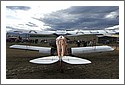
With
the imminent invasion of Australia came a call for an interceptor fighter
to defend our shores. It was readily apparent that supplies from either
England or America were going to be unreliable, so the decision was taken
to build one here. This was not a new idea, for as far back as 1938, even
before the first one was produced, the Wirraway was the subject of a study
to guage the feasibility of turning it into a fighter. It was was quickly
realised however that this particular route was a dead end.
With the urgency of this new call,
the decision was taken to build a fighter using as many parts from the
Wirraway as possible. This project was dubbed the "Wirraway fighter". A
high rate of climb, good pilot protection, good fire power and good manoeuvrability
were the desired features. To this end it was decided to arm the Wirraway
fighter with 20 mm Hispano cannon, fit armour plating around the cockpit,
oxygen bottles and oil tanks, and a powerful motor. The most powerful motor
readily available was the Pratt & Whitney R-1830-S3C4-G, a 1200 hp
twin wasp radial. The time given to complete the project was a ridiculous
three months. Due to this restriction no prototype would be made.
Undaunted, the staff of CAC (Commonwealth
Aircraft Corporation) threw themselves into the work, only to immediately
strike problems. Due to the expected strain of battle, and the substantially
greater roll rate, the outer sections of the wing were to be markedly shorter
than those of the Wirraway, as well as being of a different section and
length . The undercarriage also needed strengthening which in turn caused
a re-design fo the undercarriage fairings. So the original idea of using
the centre section of the Wirraway wing including the undercarriage was
scrapped. Instead the section was rapidly modified within the original
shell so that the Wirraway jigs could still be used.
The next problem was the cannon. A
source was not found in the country, and there did not seem to be a firm
that was able to manufacture a weapon in time without a sample. Fortunately
an RAAF sergeant who had served in the middle east had brought an Hispano
cannon home as a souvenir, and offered it as a pattern. Then it was discovered
that we had no source of 20 mm ammunition. This was solved by deciding
that the first of the new fighters would be armed with rifle calibre machine
guns while the production of cannon and ammunition got under way.
The shortened fuselage was of steel
tube construction as was the Wirraway, but the rear decking was wooden,
and the rudder and fin were redesigned with a trimming tab and additional
fin front attachment, changing that Wirraway part as well. The doubling
of engine power required the re-stressing of the front section of the fuselage,
and the expected stresses of battle the re-stressing of the rest of the
airframe.
Sixteen weeks after the first drawing
was produced, the first production model rolled out. Despite superficial
similarities, it was obviously not just a modified Wirraway, and the name
Boomerang was chosen.
Test flights filled the next two months,
with no major flaws showing up, but a number of small annoying faults such
as brake fade, and an excessively heavy rudder. These and other niggling
things were seen to and the RAAF proceeded to fly the Boomerang against
the Kittyhawk, Airacobra and Spitfire. In competition with both the P40
and the P39 the Boomerang held its own in all aspects except speed. The
Spitfire however was superior in all aspects except range. In summation
by no. 2 OTU the Boomerang was found to be wanting, and suggested that
it would be totally outclassed by the Zero. It recommended that the new
machine be used as a training plane, or in a home defence situation where
it would not come into contact with Japanese fighters. If it ws sent to
a forward area, night use only was advised.
This notwithstanding, the RAAF ordered
in all, 250 Boomerangs, many of which served in New Guinea. A turbocharged
version was designed and flown, but it never reached production. The more
obvious shortcomings of the design led to a totally new fighter being designed,
called the CA-15.
Eighty three & eighty five squadrons
received their new fighter, and spent the war in home defence duties. Eighty
four squadron went to New Guinea with theirs and operated them in their
designed role as fighter interceptors without much success. After eight
months they swapped them for P40s.
Four and five squadrons had the most
notable success with the type. Its excellent manoeuvrability and rate of
climb, combined with its unequalled pilot protection made it the perfect
machine for army co-operation. With dazzling ability at low level, four
and five squadron "Boomer boys" and their Wirraway counterparts became
the bane of Japanese patrols. In radio contact with ground forces it was
possible for a Boomerang with its engine throttled back to sneak up on
the enemy, strafe them and disappear without the enemy having time to take
a bead on them.
If the opposing forces were very close,
not uncommon in New Guinea, the pilots would get close enough to identify
uniforms before opening fire. If a ground force radio was out, a wire with
a message attached to it would be strung between two trees, and the Boomer
pilot would retrieve it with a hook. In one instance a detachment was under
heavy fire from a tree top sniper nest. A Boomerang was seen nearby, and
one digger put his slouch hat onto the end of his Owen gun and waved it
over his head. The pilot noticed this, appraised the situation and obligingly
cut the top of the tree off with his cannon.
Another role in which these nimble
aircraft excelled was artillery spotting. After a recce they would inform
the local artillery battery of the target and then fly around it as the
bombardment came in, and direct the fire until the target was destroyed.
If the target was out of range of the artillery, an RNZAF Corsair squadron
would be led to the spot, and the Boomerang pilot would mark the target
for them with a smoke bomb. In this way, to the Kiwis the Boomer boys became
known as "Smokey Joes". Indeed 20 Sqn. RNZAF attributed the most effective
strikes of their tour to Smokey Joes leading them to targets. Even the
local American fighter squadrons liked the Boomerang, though for different
reasons. The artillery missions were so annoying to the Japanese that they
would always send fighters to intercept them, giving the P38 jockeys plenty
of trade!
With the end of the war and the production
of more versatile types such as the Mustang, production of the Boomerang
ended and they were phased out of service. Ironically, shortly before the
end of the war, Wirraway production was restarted and that machine was
kept on the RAAF register longer than its replacement, the Boomerang.